Quality inside programme for onion sets: extra quality check
Between 5,500 and 6,300 hectares of onion sets are grown in the Netherlands every year. A small portion of these is planted in the autumn. The rest follows the turn of the year, as soon as weather conditions permit. The earlier harvestable onion sets have now gained their place in the market and are indispensable. They can count on considerable interest from growers, processing companies, exporters and direct suppliers.
Before the onion sets are planted, extensive quality control takes place to guarantee the desired quality of the crop. NAK Horticulture monitors and promotes the quality of seeds and planting material with thorough testing and analysis, something for which the Netherlands is renowned. In addition, onion seedling producer Broer uses the Quality Inside quality label, owned by Bejo and De Groot en Slot. This serves as an extra quality control measure on top of that carried out by NAK Horticulture, to further guarantee the quality of the planting material. What exactly happens in that process and how are pathogens detected?
Field inspections
Phytopathologist Jan Hoogland of Bejo takes us through the process of the Quality Inside programme. It starts in the field with field inspections of the first-year seed onions. "How is the growth progressing from the start, what do you find and what does it look like in the field? There you can already assess the initial quality and get a better picture of the product we are bringing in." During the harvest, samples are also taken for quality control. Plant material is also kept separate for grow-outs. This involves growing new plant material to assess its quality and check for any diseases.
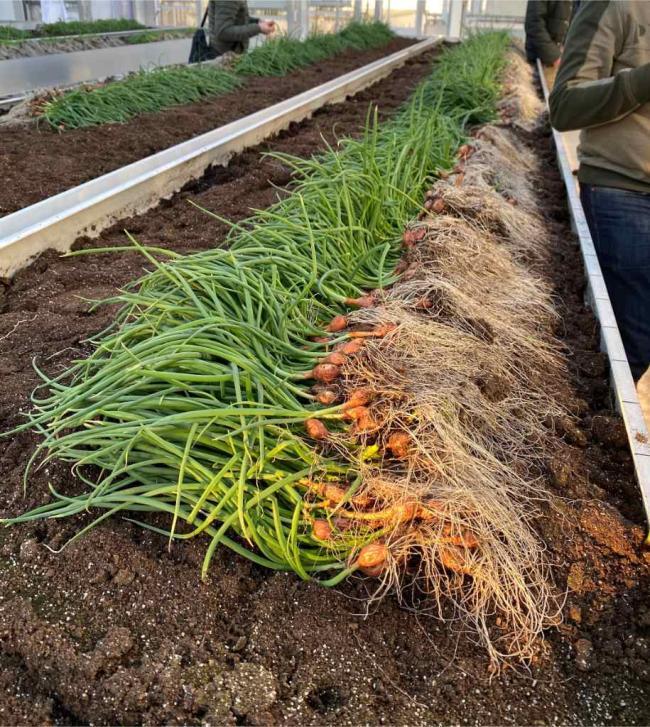
At least 1,000 plants from each batch of planting material are tested for a grow-out, says Hoogland. "We plant these and place them in a greenhouse under the right climatic conditions. You might think that a variety is a variety, but every batch from a field is different and is given its own lot number. Each lot number is tested with a grow-out. We look at how many plants do not germinate and what diseases we encounter."
Onions can be lost due to fusarium or pinkroot, for example, while others remain dormant, he continues. "We also check for the presence of head rot and downy mildew, among other things. A climate is then created in which it becomes apparent whether a batch contains downy mildew. We collect planting material that does not sprout, cut it open and leave it to incubate for a week. This allows us to see whether there is any fungus present and, if so, what type it is." He explains that action is taken as soon as a pathogen is found.
Heat treatment
Depending on the disease found, treatment is carried out. This can be done by heat treatment of the planting material, which kills the spores, but if fusarium is found, the batch must be re-examined. Once the batch has been treated, another grow-out takes place to check whether the batch is free of diseases and defects. This is done in addition to the inspections carried out by NAK Horticulture, to provide extra assurance of the quality of the onion sets.
Hoogland notices every year that logistics are a challenge when there are setbacks in the quality of a batch. "Time is quite tight with the grow-outs and the delivery of planting material. You want the grow-outs to be as close as possible to the delivery dates to the growers. For example, if you want to deliver planting material in mid-January, you start the grow-outs at the beginning of December. You want the same growth as a grower gets, so the timing of planting is very important. You should not plant too early, because then the onions are still dormant and will remain so. In that case, the result is not representative. If a batch fails the quality assessment, an alternative must be found."